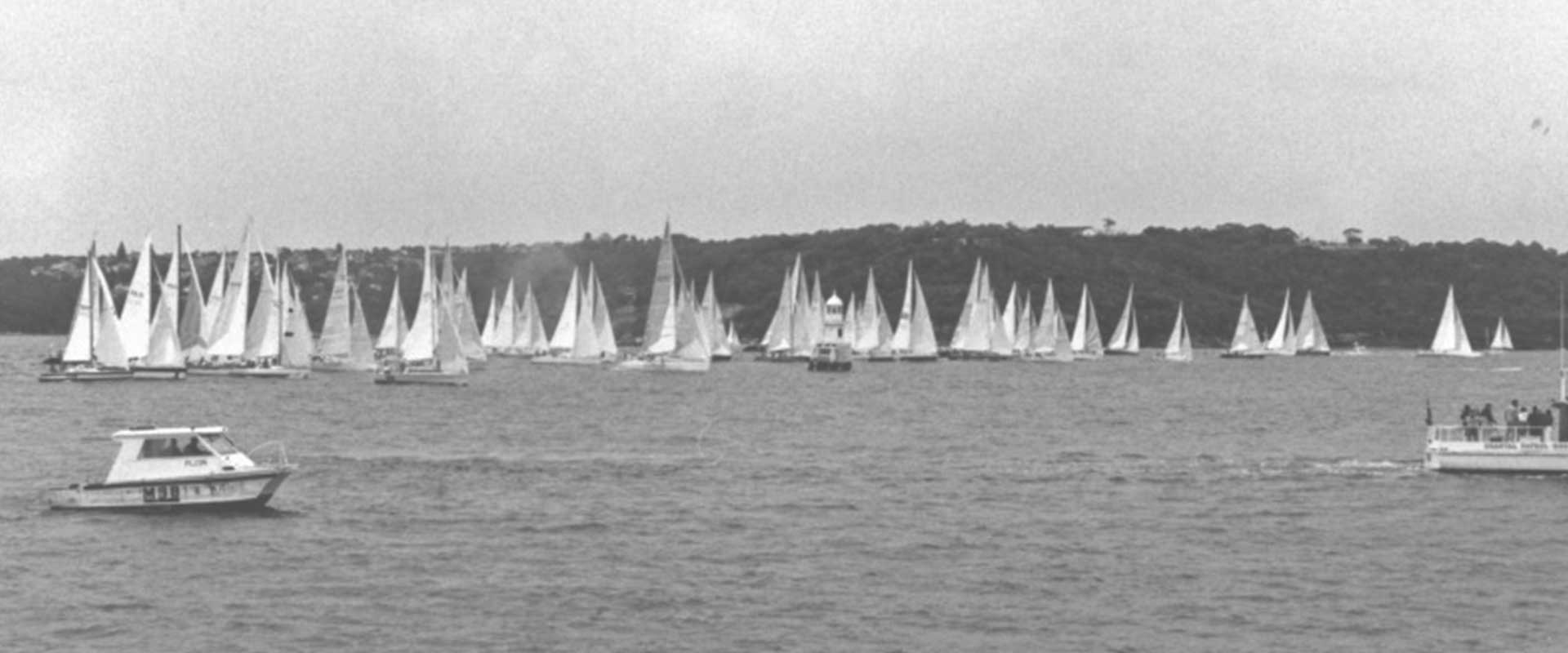


| Americas Cup 1974 | |
|---|---|
 |
Americas Cup 1974
|
| Daily Telegraph America's Cup Souvenir 22nd August 1974Andrew Spring kept this article because he was good mates with Ben (Bob Miller) Lexcen. They both raced Solings at MHYC, and my mum grew up next door to him in Woolwich, where he lived with his aunt. Dad just kept the clippings. But we had an early inside scoop on the Keel, he drew it for us one night, when the original concept was just inverting the keel to get the ballast lower, he then realised he could get more keel depth when heeled, within the rating, by adding the wings (From son Drew Spring) WHAT IT'S ALL ABOUT History of Americas Cup From PIERS AKERMAN at Newport123yr-old trophy lured scores to spend millionsTHE America's Cup trophy, valued at $1000 in 1851, has cost scores of challengers millions of dollars but no one has succeeded in dislodging it from its perch in the New York Yacht Club's trophy room. The rather ugly cup, respectfully dubbed "The Auld Mug," by Sir Thomas Lipton, who unsuccessfully competed in five challenges, remains the international symbol of yachting supremacy. Ironically, the first race for the cup was organised by the British Royal Yacht Squadron to coincide with the first world's fair which was staged by Prince Albert. The cup, which was then known as the Royal Yacht Squadron's One Hundred Guinea Trophy, was won by an enterprising group of American yachtsmen in their schooner, The America. Since then it has never been won by a yacht from any other nation. The America's Cup has become a sporting legend, surrounded by snob appeal, undercurrents of scandal and the sheer beauty of the competing boats. These elements of wealth, prestige and controversy have lent as much excitement to the event as the actual competition, giving the America's Cup a special place in sailing history. The original America was a swift yacht built along the lines of an American pilot schooner by George Steers, a U.S. naval architect famous for his designs of all types of vessels from small ships to huge clipper ships. America and the yachts she faced in the Royal Yacht Squadron race around the Isle of Wight were true seagoing vessels. America defeated her rivals so handily that when Queen Victoria inquired about the progress of the race and was told the name of the winner, her aide added regretfully, "And there is no second, your Majesty." The owners of the America, all members of the New York Yacht Club, deeded their trophy to the club in 1857.  It was given over with the condition that the club placed it in international competition forever and that any foreign yacht club could challenge for a match with a vessel of between 30 and 300 tons. The first challenge was from the British millionaire James Ashbury in 1870 with his schooner Cambria, which later became the first English yacht to sail through the Suez Canal.
Cambria was defeated and the first of many America's Cup tirades poured forth from the indignant Briton who refused to abide by an adverse protest decision. The following year he challenged again in the yacht Livonia, which was beaten in two races by the U.S. yacht Columbia. Columbia was disabled in the third race and the Americans substituted the yacht Sappho, which won the next two races. The Americans then claimed they had won four races out of a possible seven and despite threats of legal action from Ashbury, they held on to the cup. Ashbury sailed home in a rage, still claiming victory. His protests were not in vain however and that was the last race in which challengers had to meet more than one boat. The Canadians were the next challengers in 1876 and 1881, with the Countess of Dufferin and Atalanta. They too joined the growing list of unsuccessful contenders. The next two races in 1885 and 1886 against English challengers were sailed in an atmosphere of good sportsmanship, and the British also went home defeated, though pleased with their sailing. Bad feeling was generated when the Scottish yacht Thistle was defeated by the defender Volunteer in 1887, and the contention between challengers and defenders grew when the Earl of Dunraven challenged in 1893 and 1895 with Valkyrie II and Valkyrie III. During both races, the verbal complaints bitterly about the tactics used by the American skippers. His anger reached a peak during the second challenge and he accused the Americans of adding ballast to the defender, thus creating a longer waterline, which makes a yacht go faster. The Americans investigated and acquitted their yacht. Furious, Dunraven sailed home, his honorary membership of the New York Yacht Club ceremonially withdrawn. The Dunraven affair shocked sporting yachtsmen around the world and there were no more challenges for several years until the tea millionaire Sir Thomas Lipton took up the cause. Lipton was determined to win back the cup for England and spared no expense in his efforts. He was up against the American yacht designer and naval architect Nathaniel Herreshoff however, and his five yachts, each named Shamrock, were defeated in 1899, 1903, 1905, 1920 and 1930. Sir Thomas Lipton's yachts won only one race out of the 18 they sailed during the five challenges, but he won a reputation in the U.S. for fairness, for being an outstanding sportsman and for being a good loser. The 1930 race, in which U.S. yacht Enterprise defeated Shamrock V, was the first to be sailed in the massive J-Class racers. The J-boats, massive 130-foot thoroughbreds, were sailed with professional captains and crews recruited from the fishing fleets and the merchant marine. U.S. millionaire Harold Vanderbilt, in Rainbow in 1934, and Ranger in 1937 defeated English challenger, aircraft manufacturer T. O. M. Sopwith and his Endeavour and Endeavour II. Ranger was the last word in J-boats, and the 1937 race was the last in which the magnificent yachts competed. The depression and the war resulted in the beautiful yachts being sold for scrap and broken up. The war, rising costs and higher taxes halted further cup challenges until 1958. The original deed of gift of the America's Cup was altered by the Supreme Court of New York State to allow subsequent challenges to be raced in 12-metre yachts. Beside the giant J-boats, the 12-metres looked puny. But the yachts were considered classics of the day and the New York Yacht Club thought it fitting that they should be chosen to carry on the fine traditions of the cup. The first challenge in the new class came from the British and was raced in 1958 between the English yacht Sceptre and the U.S. yacht Columbia. The British again went home defeated. The next challenge in 1962 saw the Australians enter for the first time, with Gretel pitted against Weatherly. Aluminium yachts make debut in challenge Aluminium yachts make debut in challenge THIS year's America's Cup battle will be the first in which aluminium 12-metre yachts will sail. There are three aluminium-hulled yachts contending, Southern Cross, the Australian syndicate's yacht, and Mariner and Courageous, both potential U.S. defenders. Intrepid and France are both wooden yachts, but they have their share of staunch traditionalist fans who keep the lively with a new-against-old argument and wood-against-aluminium stand. Southern Cross, a lean, hungry-looking yacht, is a most impressive sight on the water and is a tribute to her designer, Bob Miller, of Sydney. The yacht was built for the Australian syndicate by Sydney boat-builder Trygve Halvorsen, in a plant tucked away from the view of the world's press at Terrey Hills, north of Sydney. Miller designed her with a deep, well-shaped bosom, quite unlike anything seen on a 12-metre yacht before. In trials off Newport, Southern Cross has shown great promise as a down-wind racer. She has also had a new flexible rudder fitted which will enable her to turn without creating drag and losing boat speed. Since coming to Newport, Southern Cross also has had an extra 228.6 millimetres (9 inches) added to her keel and has been given more lead which has improved her windward ability markedly. She has received and successfully used her new Kevlar mainsail, a new mast, the most refined spar yet seen on an Australian 12-metre yacht, and has been tuned to perfection. Courageous, one of the new U.S. aluminium yachts, is a more traditionally designed boat. Photo caption: The Southern Cross is fitted out at Newport for the clash with France. Designed by Olin Stephens, who has designed all but one of the post-war defenders, Courageous is undoubtedly a fast boat. France, the French syndicate's four-year-old entry, has been redesigned but nothing startling has been added. She has a new mast and new sails and her hull has been altered giving her a sharper line from bow to keel. But for all practical purposes she is the same boat that Gretel II beat 4-0 in 1970. Intrepid, the twice-successful defender, is also an Olin Stephens-designed yacht. She beat Dame Pattie in 1967 4-0, and Gretel II in 1970 4-1, after some redesigning by Britton Chance. Currently she is almost back to the original design intended by Stephens and has shown surprising speed off Newport. Mariner, the third U.S. boat contending for the title of defender, has become a bit of an embarrassment to her crew and certainly to designer Britton Chance. The red-hulled yacht laid an egg in her Newport trials. The sharply chopped stern, which has become a trademark of Chance-designed yachts, sat firmly in the water and held Mariner back. But she has been redesigned and is still in the running. A JURY TO HEAR PROTESTSTHERE will be an international jury this year to decide all protests and interpretations of racing rules for the first time in cup history. The members of the jury are Dr Beppe Croce, of Genoa, Italy, the president of the International Yacht Racing Union, Arthur Barron, of Wimbledon, England, and Livius Sherwood, of Ottawa, Canada. William Foulk will be the chairman of the New York Yacht Club's race committee, and there are five other members. There is also an auxiliary race committee with 12 members. Quiet mob of Aussies at Newport AUSTRALIA has mounted the most serious challenge for the historic trophy that Newport has ever seen. The Southern Cross syndicate is a well-disciplined unit that has been in training for this season's racing series for more than a year. Newporters, who enjoyed the rowdy, fun-loving sailors from Down Under and cheerfully drank with them in previous challenges, have found this year's team to be something new. The Australians are rarely seen in the waterfront bars and dockside discos of Newport during the week. They don't have a curfew. But their strict training regimen acts as one in all but name. All members of the Southern Cross syndicate, including the crews of the Bob Miller-designed Southern Cross and her trial horse, Gretel II, and the young drivers of the boat tenders are up before seven each morning taking part in a rigorous exercise program. "You just can't go out carousing and cope with the work," one crew member said. "After a workout in the morning, a full day's sailing and a few hours' work on the boats at night, all you want is sleep anyway." Alan Bond, a stocky young Englishman who made his money in Western Australia, and head of the Australian syndicate, has told his men to cultivate the killer instinct found in U.S. yachtsmen. Every crew member has signed a pledge of silence that bans them from making comments to the press or releasing any material relating to the Australian challenge. All statements about the Australian effort must come from syndicate manager Brian Leary, or Bond himself. Leary, a genial individual, is easy to talk to on any subject but the challenge. When asked about the Southern Cross he usually makes a short, succinct statement and then expands it with a little off-the-record afterthought. The Australians are staying at Chastellux, a luxurious mansion overlooking Newport and the harbor. They have put in a few holes for a golf course and the lawns are spotted with huge barbecues they are using to roast the beef they brought with them. The 24 carcasses of Australian meat are typical of the meticulous victualling that took place in Australia, as are the 24,000 cans of Courage's specially brewed America's Cup beer. The crew members have been given the use of six small Laser yachts by the Ida Lewis Yacht Club, Newport's oldest and most prestigious club, and most of them spent their Sunday lay days holding impromptu races against the local yachtsmen. Photo captions:Alan BondBob Miller Our first attempt won world admiration THE first Australian challenge for the America's Cup by the late Sir Frank Packer with Gretel in 1962 caught the sailing world unawares. The series against the U.S. defender, Weatherly, was one of the most colourful series ever raced and won the admiration of the yachting fraternity. Australia, as an unknown quantity in yacht design, was even assisted by the New York Yacht Club, which allowed Sir Frank to use the U.S. yacht Vim as a trial horse. Australian designer Alan Payne was allowed to use U.S. test-tank facilities and American-made sails were made available to the Australians. Gretel, named for Sir Frank's first wife, was built by the Halvorsen brothers, of Sydney. The yacht was perhaps the fastest 12-metre to be built at that time. The only snag was Sir Frank Packer - and his failure to nominate a skipper for the yacht until less than three weeks before the first race against the Americans. Jock Sturrock, an Olympic yachtsman, and Sydney skipper Archie Robertson, were both in the running. Sturrock was given the nod not too late to do any really effective training with his crew. Gretel showed potential speed in that first match race but it was not until the second race when Sturrock, with a crew he chose himself, threw the Americans into panic. In fresh westerly winds of about 18 knots, Gretel surfed past the American defender, skippered by Bus Mosbacher, to win by several minutes. The Australians missed the chance of winning the trophy by declaring the following day a lay day. The fresh winds they excelled in died and the rest of the series was sailed in fluky conditions. The Australian morale was destroyed and they lost their next three races. In 1967, the Australians returned with a new boat, Dame Pattie, for an uninspired challenge. The U.S. yacht Intrepid, designed by Olin Stephens, was more than a match for the Australians and Bus Mosbacher sailed her away to win by four straight races. Undeterred, the Australians were the first to lodge a challenge for the 1970 series and set a course for controversy. Sailing first against the French syndicate headed by the testy Baron Bich, Australian skipper Jim Hardy won four straight races. Undefeated, Gretel II went on to do battle with the American defender Intrepid, skippered by Bill Ficker. Ficker won the first race, but the second erupted into a bitter furore. The New York Yacht Club, the complainant, was also the judge and jury.
The record states that Intrepid won the series four-one, but in Hardy's book, the series was won by the New York Yacht Club three-two, a score he intends to even up this year. Photo captions:
THE PEOPLE BEHIND THE CUP SERIES THE challenge for the America's Cup is being carried on this year by a group of men linked only by their mania for the challenge and their avid enthusiasm for the chase. They are Baron Marcel Bich, the Bic ballpoint pen millionaire, who is heading the French syndicate for the second time, Australian real estate development millionaire Alan Bond, who is picking up the bills for the Southern Cross syndicate, and three groups of U.S. yachtsmen ranging in manner from the ultra-conservative types of the New York Yacht Club to wild Southerners eager for battle on land or sea. Le Baron Bich, who vowed four years ago that he would never return to Newport for The America's Cup, is back with two of his 10 children-his son Bruno, who is the frontman for the French syndicate, and Francois, who is the only family member in the crew. Unlike the last challenge, which Le Baron dominated with his temperamental outbursts, the French have kept to themselves this year and maintained a low profile. Bruno Bich, 27, a tall and likeable young man, gives the impression that the French would like to win but not if it means making too much of an effort.
"The French character is too hard to control." Bruno has indicated that the French challenge this year is mainly for the practice and that his father will build an aluminium boat for the next cup series. When the Baron was asked why he had returned to Newport after vowing never to do so, he simply shrugged and said with Gallic charm:
The American crews, for the first time in the history of the cup, are pushed for money and have adopted a low-key approach to the cup defence. There are three U.S. syndicates competing for the role of defender and their crews reflect widely varying yachting styles. Courageous, one of the new U.S. aluminium boats, is regarded as an old-guard boat with an establishment-backed skipper, Bob Bavier, who is a favourite with the gentlemen from the New York Yacht Club. Bavier and his crew members have taken over the Auchincloss estate, Hammersmith Farm, where Jackie Onassis grew up. The crew members are required to dress for dinner in smart uniform blazers and do not spend any time in Newport's restaurants. The other U.S. crews are less stuffy, and can be found in the Black Pearl, the Candy Store, the Electric Elephant or any of the other night spots around town. Ted Turner, a wild seat-of-the-pants sailor from Atlanta, Georgia, has a crew of hell-raisers on Mariner who set out each night intent on lusty enjoyment. The young Southern skipper's saltier comments about the New York Yacht Club barred him from entry to the august society until recently, and his devil-may-care attitude to The America's Cup still sends a few shudders through the establishment. Intrepid skipper Gerry Driscoll, a relaxed Californian shipyard owner, is confident his seven-year-old yacht still has a chance and her crew is young and eager to win. Photo captions
DEFENDER TO BE NAMED LATENO EARLY decision can be expected in the choice of a U.S. defender for The America's Cup. A close elimination series is being conducted between the three boats vying for the honor by the New York Yacht Club's race committee. Intrepid, the twice-successful wooden-hulled defender, is the favorite with the armchair admirals, but the New York Yacht Club's favorite is Courageous. Mariner, billed as the million dollar mistake, is overcoming earlier shortcomings. After a thorough change of design from the midships aft, and a new skipper - Dennis Conner - Mariner now appears to have a chance to get up. The New York Yacht Club is racing the boats in pairs now on The America's Cup course. The club need not name a defender until September 3. IT'S OUR CUP!We'll thrash France and pip the Yanks Campbell sums up our chances at Newport TWO OF the world's largest and fastest racing yachts will begin a duel of tactics, speed and crewmanship off the New England coast of the United States early tomorrow that will take one to the Everest of world yacht racing - the America's Cup challenge match. The yachts are Australia's new super 12-metre yacht, the mustard-hulled Southern Cross, skippered by Jim Hardy, and France, the revamped veteran of the 1970 challenge, sailed by Jean Marie le Guillou. The winner of their best of seven-race series will become the 22nd challenger for The America's Cup. This is the fourth Australian challenge, and our best in terms of boat, sails and rig, crew, skipper, and the organisation, finance and expertise behind her. I believe Southern Cross will repeat Gretel II's crushing 4-nil win over France in 1970. I predict that the New York Yacht Club will once again choose the Olin Stephens-designed boat Intrepid to defend the Cup - for an unprecedented third time. The challenge for the Cup on September 10 will be the closest and hardest fought in more than a century. But given any three-hour luck, I believe Southern Cross can win the Cup - by probably four races to three. Jim Hardy and his crew are showing an air of quiet confidence that they will trounce the French, and one of the grim determination to avenge Gretel II's unlucky 4-loss to Intrepid in 1970. There is good reason for their optimism with the Bob Miller-designed boat. And Jim Hardy, the helmsman, is Australia's best and most experienced racing skipper. Hardy sailed Gretel II brilliantly in the 1970 challenge, winning two races but losing the one on a controversial protest. He has as his tactician Hugh Treharne, the former Sydney 18-footer champion, who has had great experience as the match racing tactician in four Congressional Cups in the U.S. The French challenger, France, is a refined version of the wooden boat of 1970 which failed so miserably because of lack of sails, rig and teamwork. The hull has been given a sharper entry, an all new rig, and plenty of sails. But the French boat arrived late in America, and although she has shown loads of speed in workouts, most of this has been in flat water. As France and Southern Cross race to decide the challenger, the Americans will sail their final trial to select the defender. The confidence that has marked previous American defences is clearly lacking this year. Two new aluminium boats were built - Mariner and Courageous. Mariner has been a distinct flop while Courageous has been only just managing to match the veteran wooden-hulled Intrepid. And the old hull must be a handicap in matching the speed, acceleration and manoeuvrability of the lighter aluminium-hulled Southern Cross. Photo captions:
BUT YOU WON'T SEE IT AS IT HAPPENS SYDNEY TV stations will screen only seven-minute film reports that will be several days old of each of the races in the Australia-France America's Cup elimination series. By MALCOLM FORSYTH The reports will be shown in the station's evening news sessions. A spokesman for the ABC said there would be no satellite reports unless the elimination series against France reached a crucial stage. The reports will be provided by the Australian news-gathering organisation Visnews - which will film for the four national networks - ABC-TV, 0-10, Nine and Seven. But each network will have its own reporter on the scene to provide commentaries for the series. The ABC spokesman said yesterday there would be several days' delay in getting the films to Sydney, as each would be edited in America before being flown here. "The races start at 2 a.m. Australian Eastern Standard Time, so it may take up to three days before viewers see the actual films on their screens here," he said. "Direct telecasts by satellite of the main challenge against America - if the Aussies beat the French - will depend on whether the American networks can be talked into doing it. "So far, they have shown limited interest in the challenge, and even less interest in the elimination series. "We are using all possible pressures to convince them to provide a direct telecast." ABC-TV will screen each race report during its National News at 7 p.m. with Ray Martin, of its New York office, giving a longer report as films arrive. TEN newsman Peter Hannrahan is expected to cover the challenge for the 0-10 Network if Southern Cross beats France. Only two are able to raceTHE RULES of The America's Cup race are such that only two boats can ever compete for the trophy. For the past 123 years, the defender has always been an American boat, with challengers coming from England, Scotland, Canada, France and Australia. The foreign contenders are required to race first. The foreign contender and the New York Yacht Club defender will then meet in the first cup race on September 10. YOUR GUIDE TO THE COURSE...The course and number of races for the series against the French is the same as for the America's Cup match, a best of seven races series sailed over the triangular course, about 24.3 nautical miles in length and comprising six legs. This gives the boats three windward legs, two reaching legs and one square run. |