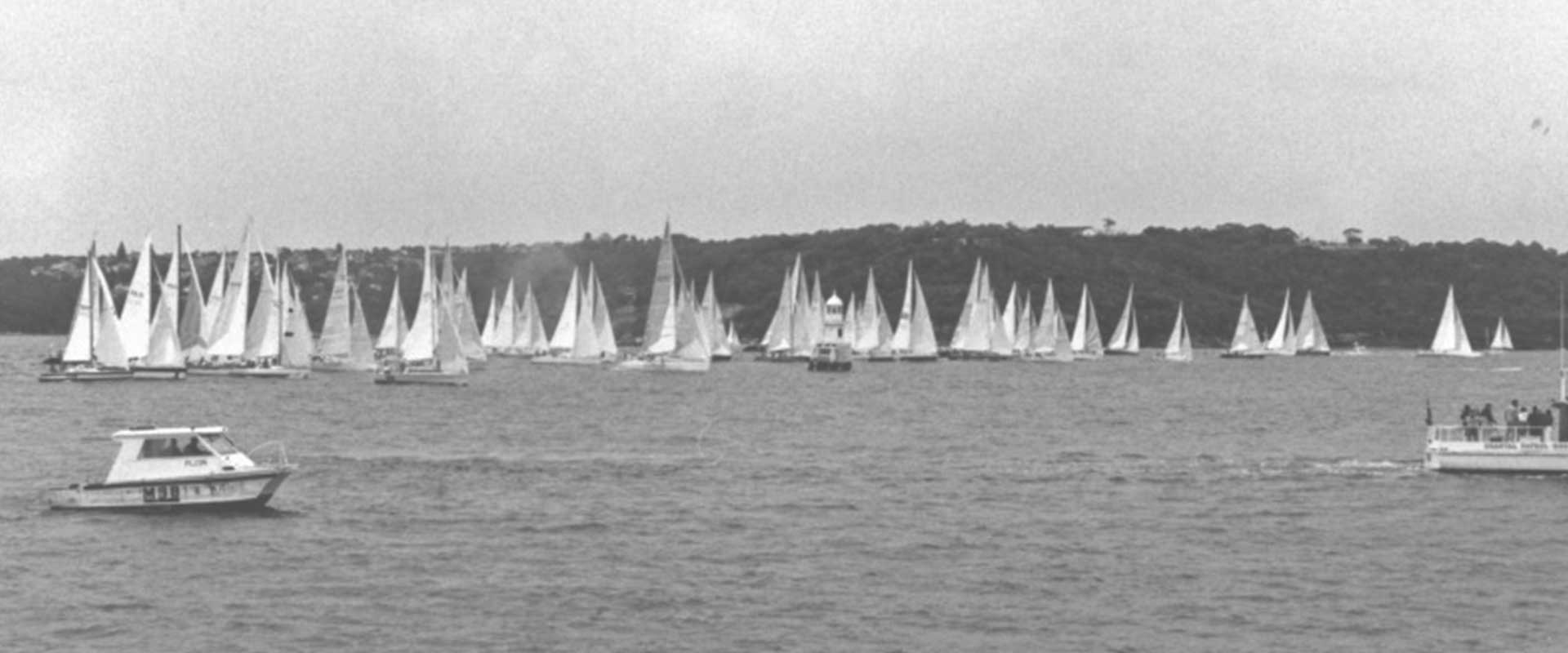


| Americas Cup 1983 |
|---|
Americas Cup 1983
Crew Photo

Articles | Hugh Treharne and the America's Cup Australia II winning the Americas Cup in 1983  Treharne (centre) was the quiet man in the 1983 America's Cup victory  America's Cup MHYC: The First 60 Years Article by: Jeanine Treharne Published: 1999 At 40 years of age, MHYC member, Hugh Treharne had a world 18-foot skiff title, world One Ton and Half Ton titles, and a win in the Fastnet Race. He was a member of the winning Admiral's, Southern Cross and Kenwood cup teams, and sailing master in countless ocean-racing successes. Like all leading match-racing yachtsmen, one dream seemed elusive: winning the America's Cup and ending the New York Yacht Club's 132-year winning streak. In 1982, flamboyant designer Ben Lexcen ushered him into the top secret shed that housed Alan Bond's third America's Cup challenge 12-metre, Australia II. Treharne couldn't believe what he saw - an upside-down keel that was pure inspiration. He immediately accepted the post as tactician, and suggested to team coordinator John 'Chink' Longley that the team wrap a 'skirt' around Australia II's keel to prevent anyone having the chance to copy her. He also helped design a battle flag that would become famous around Australia: the boxing kangaroo with the red eye. In order to finance the trip, Treharne and his wife Jeanine rented out their house and sold their car. In May 1983, they flew with their two young children and the team to Newport, Rhode Island. Four families, the Treharnes, Bertrands, Longleys and Schnackenbergs were squashed into two rented houses. Unmarried crew members were housed two or three to a room at the gracious old summer house, where fitness training began each morning at 5.30, ending with a huge breakfast and pep talks, planning strategies and assigning tasks to the 30-strong team. The families and crew lived commando style, fiercely protecting team secrets and watching any new girlfriend of unmarried team members with great suspicion. The first night, John Longley's reconnaissance mission resulted in wonderful news for the team; he announced, beaming We have a good chance of winning this. The local guys reckon Dennis has been drinking very heavily at the Black Oyster every night. He's worried about us!' Australia II kept winning and winning, and the Americans in Newport were worried. Attacks began against the eligibility of the keel, and personally against Ben Lexcen. The aim was to get the sailors' minds off their task. Team manager, Warren Jones, bore the brunt of the attacks and won every battle. His hair turned from black to grey in four months. Invaluable advice and wisdom came from the great Ken Beashel and Perth World War II heroes John Fitzhardinge and Newton Roberts. After the America s Cup win, Fitzhardinge told the team that they had enacted the true meaning of mateship, something he had not seen since his time in the trenches in World War II. The team comprised great individual champions such as Olympic bronze medallist Colin Beashel, who spent 40 minutes atop Australia II's mast during one race; seven-times 18-foot skiff world champion Rob Brown, who devised the intricate code system for the tender yachts, reporting on wind conditions at each mark; mastman, world Etchells champion, Phil Smidmore, whose judgement of wind shifts was impeccable; the incredibly disciplined Peter Costello, who pumped the crew along like a man possessed during the countless tacking duels, and champion Olympic rowers Brian Richardson and Will Baillieu, who ground the winches without a sign of fatigue. Ben Lexcen was chief court jester, putting a brave face on constant attempts to discredit his designing ability and usually keeping a step ahead of the opposition in the espionage stakes. His most famous trick was to carefully draw a fake design of Australia II's keel and leave it 'by mistake' in the large photocopy machine at the Newport Boatyard. It was there for 15 minutes before he 'desperately' phoned the boatyard to ask them to keep the plans for him and not to show anyone. That night the news was all around Newport and in the media. Next morning there was cheering for Ben at the crew breakfast as the photo of his 'design', and the claim that this was the real design of the secret keel was front page news in the Newport Times. The close-knit, spartan living gave the Australia II team what they needed to make a miraculous comeback from staring defeat in the face (at three-one down) and needing three straight wins to take the cup home to Australia. Even top Aussie sportsmen thought it impossible. A leading AFL coach refused to be photographed with John Bertrand after the fourth race, saying 'I shouldn't be photographed with a losing team'. John's immediate retort was 'Come back in four days' time and see who are the losers'. Australia II was leading the next race by 5 minutes when the time limit ran out. The Americans claimed that Australia had been 'sandbagging' in the downwind legs before the cup races and now they were amazingly fast. What they wouldn't accept was that downwind performance had been Australia's Achilles heel until John Bertrand perfected the art of steering with the unusual keel and Hugh came up with a breakthrough spinnaker design that gave Australia II the winning edge. The rest is Australian sporting history. Three straight wins, the last seemingly impossible until the final downwind leg when Australia II gained a full minute and crossed just ahead of Liberty, forcing a 15-minute tacking duel of 47 tacks, where the team did not falter for a moment. The team was duly rewarded with a visit to the White House and to the Australian Embassy in Washington, where Ambassador Cotton told the team they had accomplished more for Australia's image in America in four months than his Embassy had been able to achieve in 20 years. It was one of Australia's greatest sporting achievements. MHYC Welcome Home Dinner |


Photos | Treharne (centre) was the quiet man in the 1983 America's Cup victory  Treharne's call for an early gybe put Australia II ahead in the final 1983 race. |